
Pain is one of the strongest purchase motivators
When someone searches for a physiotherapist, they are almost always in pain - physical pain that is limiting something they care about. They can't run. They can't pick up their child. They've been waking up at 3am. They tried the NHS and were told the wait is four months.
This is a searcher with high intent and high motivation to act. The only question is whether your landing page removes the barriers between their search and their booked appointment quickly enough - before they click back and try the next result.
The barriers in physiotherapy are different from legal or financial services. There's no fear of cost surprise (most sessions are clearly priced). There's no stigma. The barrier is usually one of three things: uncertainty about whether they need a GP referral first, doubt that the clinic can see them soon enough to be worth booking, or not being sure whether their specific condition is treated there.
A physiotherapy landing page that directly answers all three of those questions above the fold will convert dramatically better than one that doesn't.
Real example: Peak Physio
The page below is Peak Physio's landing page, built on lander.rs. View it live at lander.rs/physiotherapist.
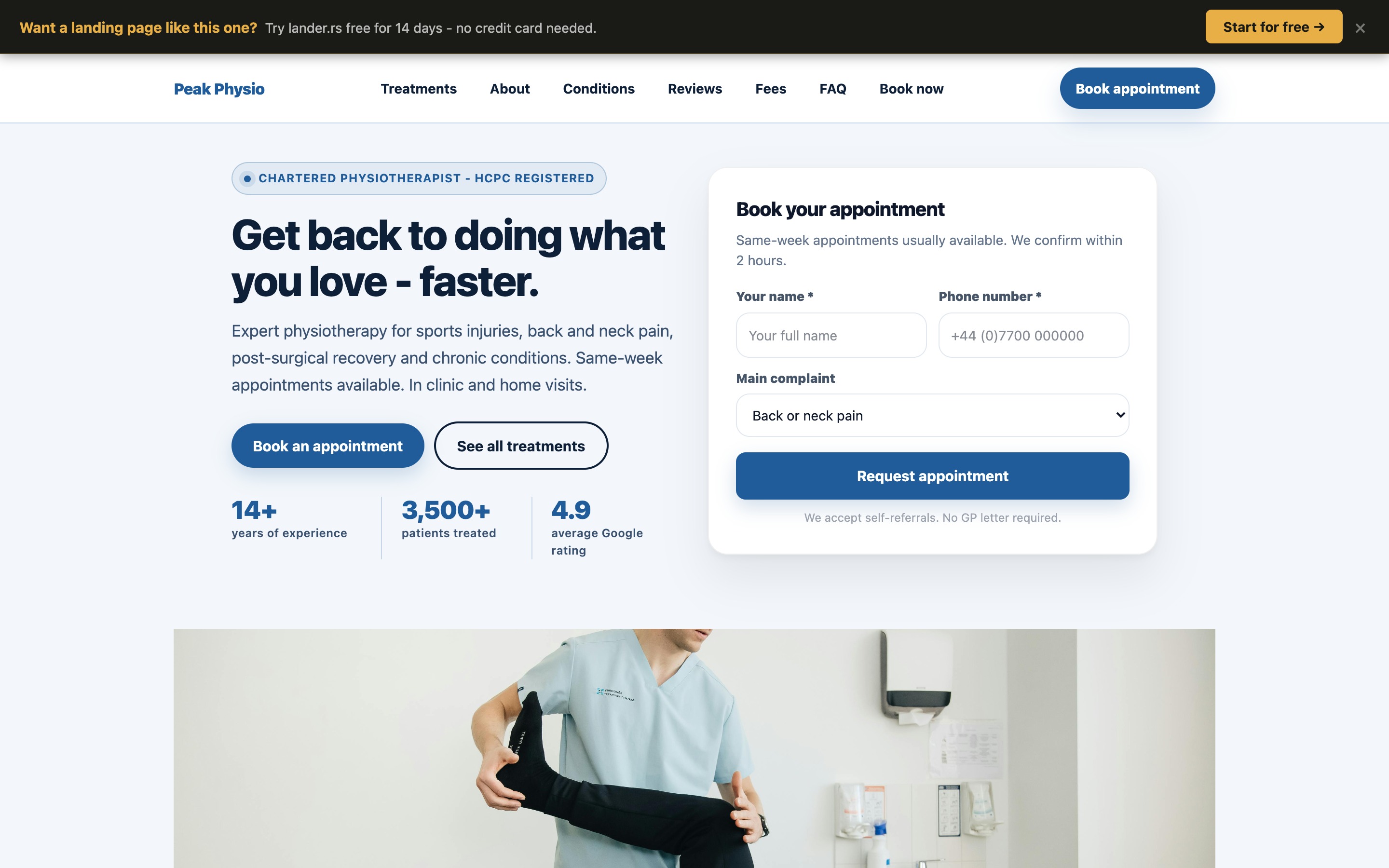
The page answers all three conversion barriers immediately. The badge reads "Chartered Physiotherapist • HCPC Registered" - credentials signal. The headline delivers an outcome promise. The booking form has a "Main complaint" dropdown and a note reading "We accept self-referrals. No GP letter required." - availability and referral signals, both visible before the first scroll.
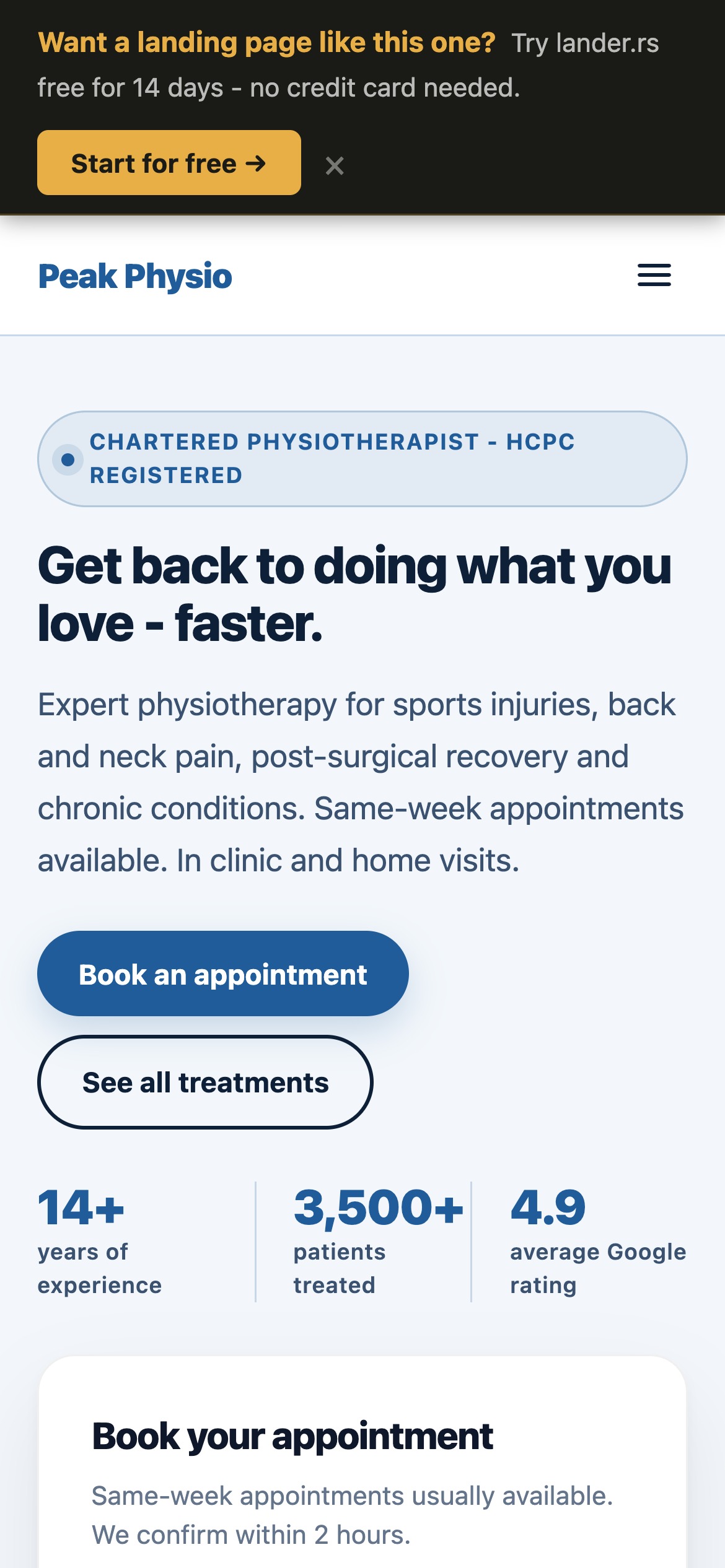
Mobile - credentials badge, headline, and the full booking form visible at 390px with no scrolling
Self-referral is the most important conversion signal
In the UK and many other markets, a large percentage of people who need physiotherapy assume they must see a GP first to get a referral. They don't book private physiotherapy because they think they can't - not because they don't want to.
This is a conversion barrier that disappears the moment you state clearly on the page that no GP referral is required. Peak Physio places this note directly beneath the booking form submit button: "We accept self-referrals. No GP letter required."
That single line converts a significant portion of visitors who would otherwise leave to book a GP appointment first - a process that could take two to three weeks and often results in the person never making it to physiotherapy at all.
If your clinic accepts self-referrals, this is not a minor detail to put in an FAQ. It is a headline-level trust and accessibility signal that should be visible in the hero, on the booking form, and wherever pricing is discussed.
The outcome headline formula
Most physiotherapy clinic websites lead with service descriptions: "Expert physiotherapy for sports injuries, back pain, and rehabilitation." This is accurate but inert - it describes what you do, not what the patient gets.
Peak Physio's headline - "Get back to doing what you love — faster." - is structured around the outcome the patient is actually seeking. Nobody books physiotherapy because they want physiotherapy. They book it because they want to run their half-marathon again, sleep through the night, or pick up their grandchildren without wincing.
The formula: [Return to the thing that matters] + [Speed advantage].
- "Get back to doing what you love — faster."
- "Back on the pitch in weeks, not months."
- "Stop managing the pain. Start fixing it."
- "Move without pain. Live without limits."
The subheading then earns the right to be specific: "Expert physiotherapy for sports injuries, back and neck pain, post-surgical recovery and chronic conditions. Same-week appointments available. In clinic and home visits." This is the service description - but it comes after the emotional hook, not instead of it.
The complaint-based intake form
Most booking forms ask for name, phone, and a message field. Peak Physio's hero form uses a "Main complaint" dropdown instead of a free-text message - and this is a more effective design choice for several reasons.
First, it pre-qualifies the lead. The clinic knows before the first call what the patient needs, which improves scheduling efficiency. Second, it reduces form abandonment - selecting from a dropdown is faster and lower friction than writing a description of your pain. Third, it signals that the clinic has seen these conditions before, which builds confidence before the first appointment.
The dropdown for a physiotherapy practice should cover the conditions that represent the majority of inbound volume:
- Back or neck pain
- Sports injury
- Post-surgical rehabilitation
- Shoulder, knee, or hip pain
- Sciatica or nerve pain
- Chronic pain or long-term condition
- Other / not sure
The "not sure" option matters - it removes the self-diagnosis barrier for people who are in pain but aren't certain what the cause is. Many physiotherapy leads are lost because the patient doesn't know if their complaint fits the clinic's scope. "Not sure" tells them: come anyway, we'll figure it out together.
HCPC registration and the Chartered Physiotherapist signal
Physiotherapy is a regulated profession in the UK. HCPC (Health and Care Professions Council) registration is a legal requirement to practice - but many patients don't know this, and many clinic websites don't leverage it.
Displaying "Chartered Physiotherapist • HCPC Registered" as a badge in the hero does two things. For patients who do know what HCPC means, it confirms the practitioner is properly qualified and registered. For patients who don't, the official-sounding language provides assurance that this is a credentialed professional - not a personal trainer or massage therapist marketing themselves as physiotherapy.
The Chartered Physiotherapist designation (MCSP/CSP membership) signals advanced professional status beyond basic registration. If your practitioners hold this, it belongs in the hero badge, not buried in an About section.
For practices outside the UK: the equivalent signals are state licensure (US), APA membership (Australia), or the relevant national registration body. Whatever credential signals that you have met the highest professional standard in your jurisdiction should be front and centre.
Same-week availability as a conversion accelerator
Pain is an urgent problem. People searching for a physiotherapist are not planning ahead - they are in discomfort right now and want to know how quickly they can be seen. A clinic that communicates "same-week appointments usually available" in the hero converts faster than one that requires the visitor to call to find out wait times.
Peak Physio addresses this directly in the booking form subheading: "Same-week appointments usually available. We confirm within 2 hours."
Both halves of this sentence are important. "Same-week" sets availability expectations immediately. "We confirm within 2 hours" removes the uncertainty of the post-form experience - the visitor knows they won't be waiting days for a reply. This is a small copy change with a measurable impact on form completion rates.
If your clinic offers home visits, this is a second availability signal worth placing in the hero. "In clinic and home visits available" speaks directly to the segment of patients who cannot travel - post-surgical patients, elderly patients, people with mobility limitations. This group is high-value and often underserved by clinic websites that only mention home visits in passing.
Conditions vs. treatments: how to structure your services section
Physiotherapy clinics typically offer the same core treatments - manual therapy, exercise prescription, acupuncture, sports massage, electrotherapy - but patients don't search by treatment. They search by condition. They search for "back pain physiotherapy" or "physio for sciatica", not "manual therapy clinic."
Peak Physio's navigation reflects this insight: it separates "Treatments" (what the clinic does) from "Conditions" (what the patient has). On a landing page, the conditions section should lead - it speaks the patient's language first, then connects their condition to the relevant treatment approach.
Effective conditions sections in physiotherapy:
- Lead with the condition name in the patient's own words ("Back & Neck Pain" not "Lumbar and Cervical Disorders")
- Follow with one sentence that validates the experience: "One of the most common reasons people come to us - and one of the most treatable with the right approach."
- End with the outcome: "Most patients see significant improvement within 4–6 sessions."
This structure - condition, validation, outcome - takes a patient from recognition ("that's what I have") to hope ("it's treatable") to motivation ("I can get better in 4–6 sessions") in three lines.
Landing page vs. general clinic website
| Factor | General clinic website | Focused landing page |
|---|---|---|
| GP referral question | Buried in FAQ or absent entirely | "Self-referrals accepted" in the hero, next to the form |
| Wait time signal | "Call to book" - leaves visitor uncertain | "Same-week appointments usually available" |
| Headline approach | Service description ("Expert physiotherapy") | Outcome promise ("Get back to what you love") |
| Intake form | Generic name/email/message | Complaint dropdown pre-qualifies and reduces friction |
| Credentials placement | About page or footer | Badge in the hero, above the headline |
| Home visits | Services page, third paragraph | Hero subheading - catches mobility-limited patients early |
| Typical conversion rate | 1–3% | 6–15% |
How to build one with lander.rs
Peak Physio's page was built in the lander.rs visual editor with no code. The structure for a physiotherapy landing page:
- ContentSection (hero) - "Get back to [activity]" outcome headline, "Chartered Physiotherapist • HCPC Registered" badge, 3-field booking form with complaint dropdown, "self-referrals accepted / no GP letter required" note, experience stats
- ImageSection - clinic or treatment photo with "evidence-based, tailored to your body" caption
- Services (conditions) - 6 cards written in patient language: Back & Neck, Sports Injury, Post-Surgical, Shoulder/Knee/Hip, Sciatica, Chronic Pain
- ImageWithText (about / experience) - years of practice, patient volume, approach to treatment
- Testimonials - outcome-specific: condition + what improved + how quickly
- ImageWithText (process) - assessment, treatment plan, recovery milestones
- Pricing - initial assessment fee + follow-up session rate, block package if offered
- CTASection - repeat same-week availability CTA
- FAQ - GP referral question, what to bring, how many sessions, home visits, insurance/health cash plans accepted
- ContactForm - name, phone, email (optional), main complaint (select), preferred appointment type (in-clinic / home visit), message
Build your physiotherapy landing page
All the components above are available in lander.rs - pre-styled, mobile-optimised, and wired to send bookings directly to your inbox. No code or developer needed.
Try lander.rs freeNo credit card required. Cancel any time.