
Quick Answer
A high-converting car accident lawyer landing page needs: a headline that names the insurer threat, a free case review CTA above the fold, a 3-field intake form, specific recovery statistics, and page load under 2 seconds on mobile. Accident victims search on their phones within hours of the collision - your page must reach them before the insurer's first call.
Why timing is everything in auto accident law marketing
Car accident legal marketing operates on a completely different timeline to almost every other professional service. The client window - the period in which an injured person is actively seeking legal representation - can be as short as 24 to 48 hours after the accident.
Here's what happens in those first hours: the insurer calls. Often the same day or the morning after. They are friendly, they express concern, and they offer a number. That number is almost always a fraction of what the claim is worth, and signing it closes the case permanently.
Your landing page needs to reach that person before they accept that call. And when they find you - usually on mobile, often from a hospital bed or the side of the road - it needs to instantly communicate: you're in the right place, call us before you say anything to the insurer.
In personal injury law, the fastest attorney to establish trust wins the client. A landing page that loads in 2 seconds and makes the right promises beats a beautiful website that takes 5 seconds and buries the phone number.
This is why a landing page - not a firm website - is the right tool for paid search and social advertising in the auto accident niche. Every extra click, every navigation menu, every page that isn't the one thing the visitor needs is friction that loses cases.
A real example: Reynolds Law Group
Below is a live page built on lander.rs for a car accident law firm. Visit it at lander.rs/car-accident.
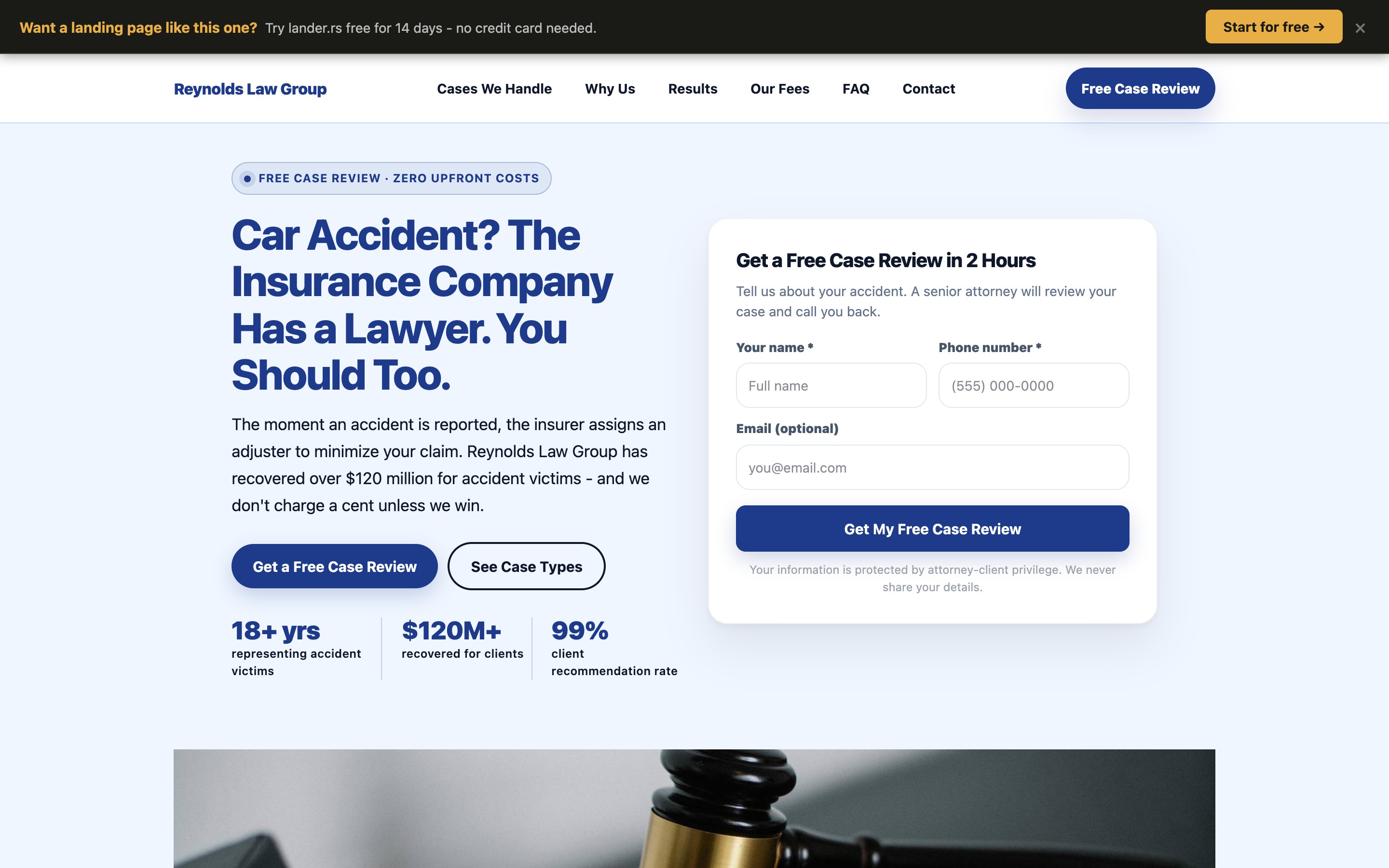
Desktop view (1440px) — above the fold
Notice the choices made above the fold:
- The headline addresses the visitor's actual situation - "Car Accident? The Insurance Company Has a Lawyer. You Should Too." This is a direct, confrontational framing that cuts through shock and adrenaline. It implies an asymmetry that the visitor instinctively understands and wants to correct.
- The badge answers the first fear - "Free Case Review · Zero Upfront Costs" before the visitor has even read the headline. Cost anxiety is neutralized in the first 0.5 seconds.
- Stats are specific and credible - 18+ years, $120M+ recovered, 99% recommendation rate. These numbers are strong enough to earn trust without being so round they feel invented.
- The form is in the hero - no scrolling required to initiate intake. The form title ("Get a Free Case Review in 2 Hours") adds a response time commitment that reduces the perceived risk of submitting.
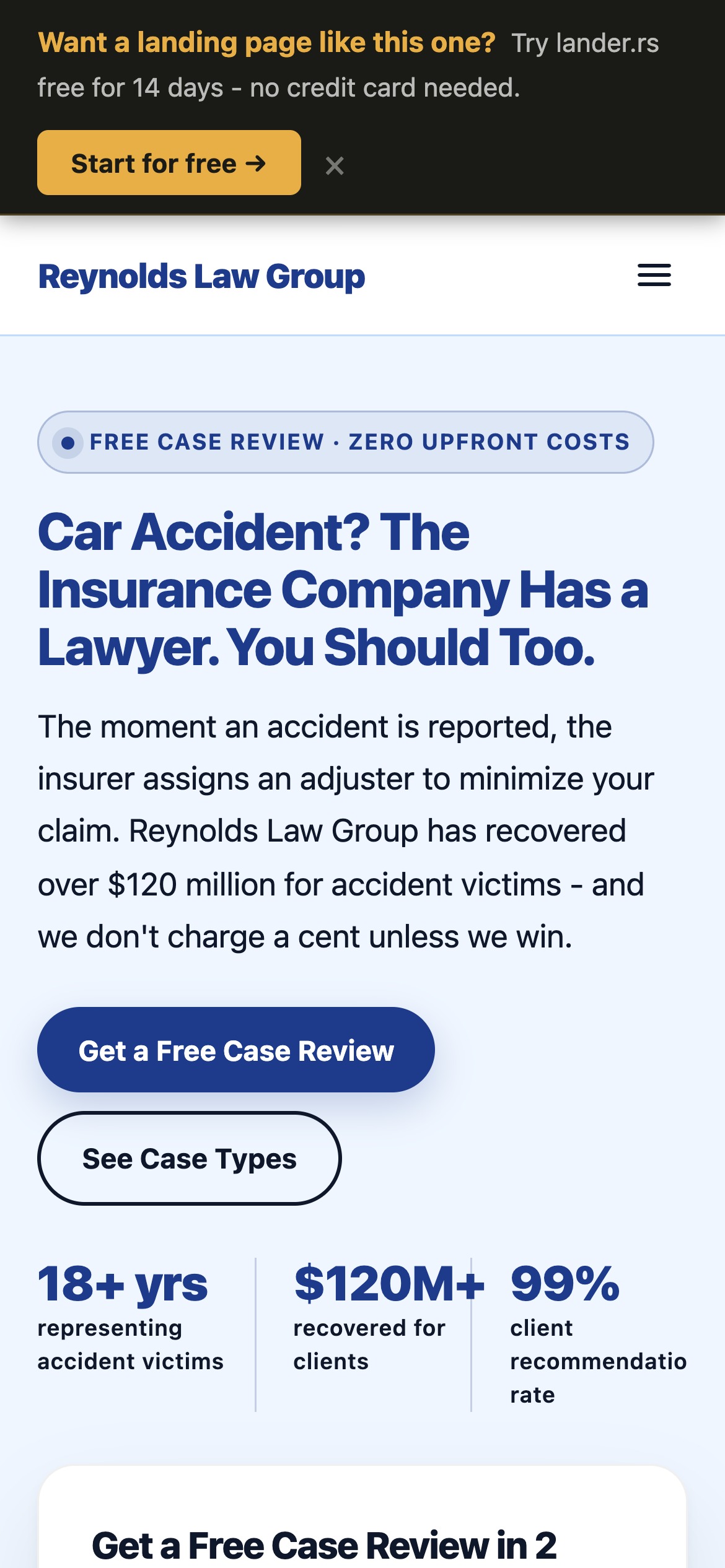
Mobile-first intake
The full headline, badge, CTA button, and stat bar are all visible on mobile before scrolling. The form renders below as a second CTA for visitors who want to read first.
Clean, high-contrast layout
Navy on light blue (#1e3a8a on #eff6ff) passes WCAG AA contrast at every font size. Easy to read on a cracked screen in a parking lot.
Mobile view (iPhone 14 Pro, 390px)
The headline formula that wins auto accident cases
Car accident headlines that convert share a specific structure: they name the threat, validate the visitor's position, and imply the solution - all in one sentence.
The formula
[Situation acknowledgment] + [The threat they haven't fully considered] + [Your positioning as the solution]
Examples that follow this formula:
- "Car Accident? The Insurance Company Has a Lawyer. You Should Too."
- "Injured in a Crash? Insurers Make Their First Offer Within 24 Hours. Don't Answer Alone."
- "The Other Driver's Insurance Company Is Already Building a Case Against You. We Build One For You."
What makes these work is the framing of an adversary. The insurer isn't neutral - they have a lawyer. That lawyer is working against the visitor right now. This creates urgency that isn't manufactured; it's real. And it positions you as the corrective force.
What to avoid
Avoid headlines that make the firm the subject: "Smith & Jones - Experienced Auto Accident Attorneys Serving the Metro Area Since 1998." This is about you, not them. The person who just had an accident doesn't care about your founding year. They care about whether you can help them today.
Speed and mobile performance: the invisible conversion factor
Car accident searches spike in the minutes and hours after collisions. The visitor is on their phone, possibly at the accident scene, possibly in an ambulance, possibly at the ER. Their connection may be weak. Their attention is fragmented by stress, pain, and the logistics of the situation.
Google's research shows that 53% of mobile visitors abandon a page that takes more than 3 seconds to load. In personal injury, where the search intent is acute and the visitor's patience is zero, the number is almost certainly higher.
Page speed is a conversion factor that most attorneys never think about because they never test their site on a slow mobile connection. Here are the things that kill speed:
- Uncompressed hero images (often 3-5MB on agency-built sites)
- Multiple third-party scripts loading in the header (chat widgets, analytics, retargeting pixels)
- Custom fonts loading from slow sources
- WordPress plugins adding render-blocking JavaScript
Pages built on lander.rs are served from fast infrastructure with images optimized at upload. There are no plugin chains or render-blocking scripts - the page is the page. On a mid-range mobile device on a 4G connection, a lander.rs page typically loads in under 2 seconds.
Building trust in the first 10 seconds
Someone who has just been in a car accident is in a uniquely vulnerable state. They are scared, possibly in pain, and being approached by multiple parties (insurers, repair shops, sometimes other attorneys from referral networks) all within a few hours. Trust is the conversion factor. Here's how the Reynolds page builds it fast:
Concrete numbers over vague claims
"$120M+ recovered for clients" is more convincing than "proven track record of results." Numbers have a specificity that vague claims don't. They imply there's a database of cases behind them. "$120 million" is a number someone will actually remember and mention to their spouse.
Specific testimonials with dollar amounts
The testimonials on the Reynolds page follow the personal injury conversion formula: specific initial offer → specific final recovery → specific mechanism (investigation, documentation, legal strategy). "They offered $12,000. Reynolds settled my case for $148,000" is a testimonial that works. "Great attorneys, very professional" is one that doesn't.
Case type specificity signals expertise
The page breaks down 6 specific collision types: rear-end, head-on, hit & run, drunk driver, rideshare, commercial truck. Each has its own card with a brief description of the specific legal dynamics. A person who was hit by a Lyft driver reads the rideshare card and thinks "they've done this before" - which dramatically increases conversion compared to a generic "we handle all car accidents" statement.
Attorney-client privilege stated explicitly
The form consent text reads: "Your information is protected by attorney-client privilege. We never share your details." This removes a real fear. People who are not sure whether to contact a lawyer often worry that submitting a form creates some kind of obligation or exposes their information. Naming the privilege directly removes that hesitation.
Designing the intake form for accident victims
The intake form is the conversion mechanism - everything else on the page is in service of getting the visitor to fill it in. Here's how to design it for maximum completions:
Keep required fields to a minimum
The Reynolds hero form asks for name, phone, and email (optional). That's it. The goal is a phone number. Once you have a phone number, you can call within 2 hours, do a real intake, and assess the case properly. Every extra required field reduces completions by approximately 10%.
Use a specific form title
"Get a Free Case Review in 2 Hours" is more compelling than "Contact Us." It sets an expectation (free), defines what happens (case review), and makes a time commitment (2 hours). All three elements reduce hesitation.
Add a timing question strategically
The bottom-of-page contact form includes "When did the accident happen?" as a select field. This serves two purposes: it helps the attorney prioritize callbacks (recent accidents are more urgent for evidence preservation), and it implicitly signals to the visitor that the firm takes timing seriously - reinforcing the urgency messaging from the hero section.
The "were you at fault?" question
Including "Were you at fault?" (No / Partially / Unsure) in the intake form is a conversion unlock. Many accident victims don't contact attorneys because they fear they were partly responsible. By asking the question explicitly with "Partially" and "Unsure" as valid answers, the form signals that partial fault is not a disqualifier - which is legally true in most comparative negligence states, and which many accident victims don't know.
lander.rs vs the alternatives for car accident attorneys
| lander.rs | Legal marketing agency | DIY (WordPress / Wix) | |
|---|---|---|---|
| Time from zero to live | Under 1 hour | 6-16 weeks | Days to weeks |
| Cost | From $15/month | $5,000 - $25,000+ setup + monthly retainer |
$20-$60/month + developer time |
| AI-generated page from your description | Yes | No | Limited |
| Built-in lead capture form | Yes, emails to you on submit | Usually separate CRM integration | Plugin required |
| Edit copy without a developer | Yes - click to edit | Requires agency ticket | Yes but fragile |
| Mobile page speed | Fast by default | Varies (often plugin-heavy) | Requires optimization |
Why legal marketing agencies are over-engineered for this
Legal marketing agencies do excellent work - for large multi-location firms with complex SEO needs, practice area microsites, and dedicated content teams. For a single-purpose intake page for car accident cases, they are dramatically over-engineered. You don't need a 6-week discovery process and a $15,000 budget to put a clean landing page in front of your Google Ads traffic.
The ROI math is straightforward
If a single additional car accident case is worth $15,000 to $50,000 in fees, then a tool that costs $15/month and improves your ad conversion rate by even 20% is one of the highest-ROI marketing investments available. The only question is why you'd pay more for the same outcome.
Build your car accident landing page
Register free
Free forever, no credit card. Full access from day one including the car accident attorney template.
Generate with AI
Describe your firm: "Car accident attorney in Dallas. 15 years, $80M recovered. Contingency fee only. Specialize in truck accidents and DUI cases." Full page generated in ~60 seconds.
Replace placeholders with real data
Swap in your actual recovery total, real testimonials with specific settlement figures, your real contingency fee percentage, and your direct phone number.
Send your ad traffic here, not to your homepage
Point your Google Ads destination URL at this page. Connect your domain (e.g. freecaraccidentreview.yourlawfirm.com). Every lead goes straight to your inbox.
See what your firm's page could look like
Free forever. No credit card. Car accident attorney template available from day one.