
The coaching conversion problem
Business coaching is a high-trust, high-commitment purchase. A founder considering a coaching engagement is evaluating whether to spend significant money, share sensitive business information, and commit personal time - often weekly - to working with someone they found online.
Most coaching websites fail to convert because they're built to impress, not to reassure. They lead with certifications, methodology names, and brand photography. What a prospective client actually needs to see is evidence that you understand their specific situation and have helped people like them move forward from it.
The coaching category also has a credibility problem. The market is saturated with coaches offering transformational results and vague frameworks. A landing page that resists this language - that speaks plainly about what the work actually involves - stands out precisely because it's the exception.
Real example: Elevate Coaching
The page below is Elevate Coaching's landing page, built on lander.rs. View it live at lander.rs/business-coach.
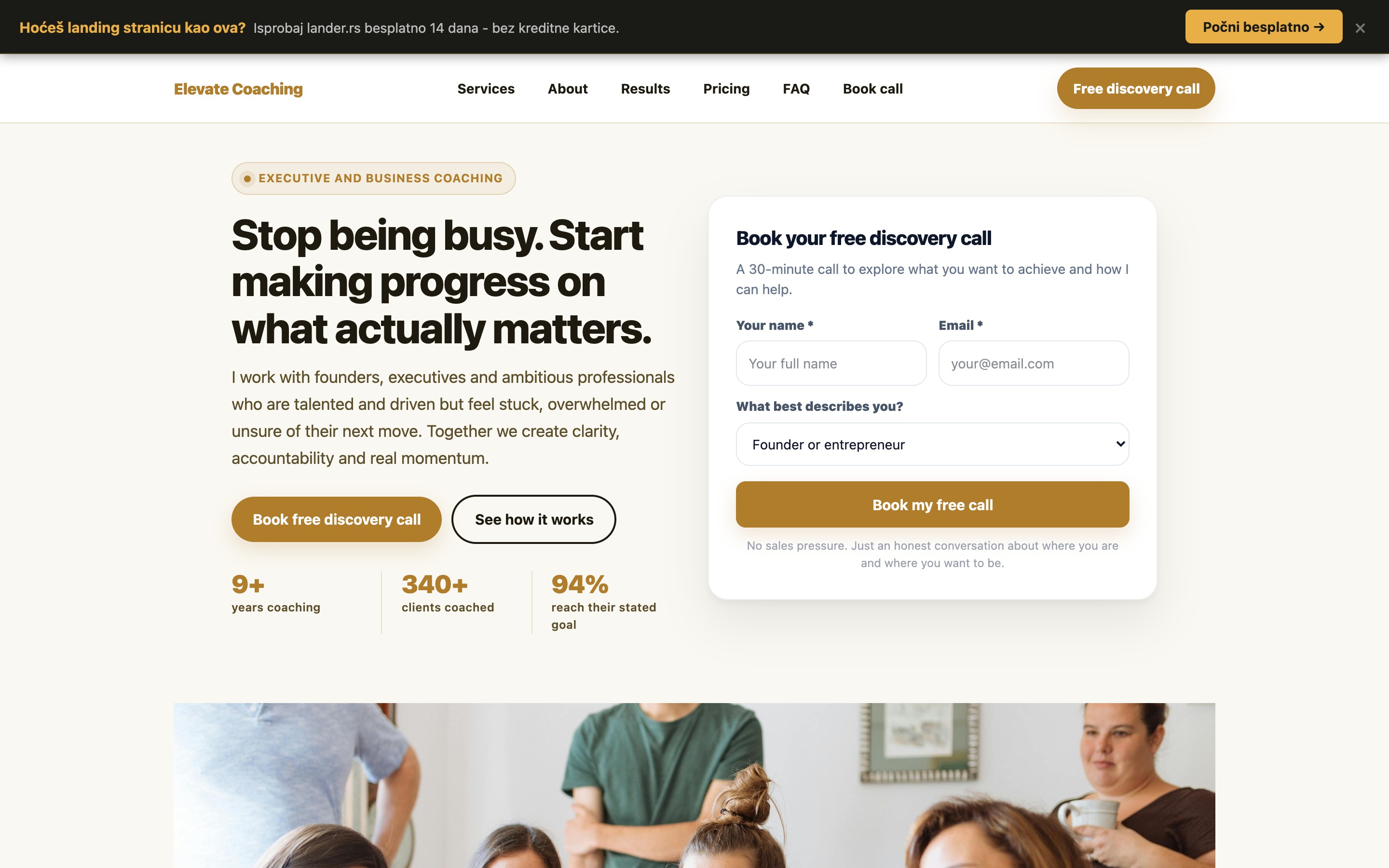
The headline - "Stop being busy. Start making progress on what actually matters." - names a problem with surgical accuracy. It doesn't say "I'll help you grow your business." It identifies the specific pattern that brings ambitious people to coaching: activity without meaningful progress. Every founder who reads this and thinks "that's me" is already partially converted.
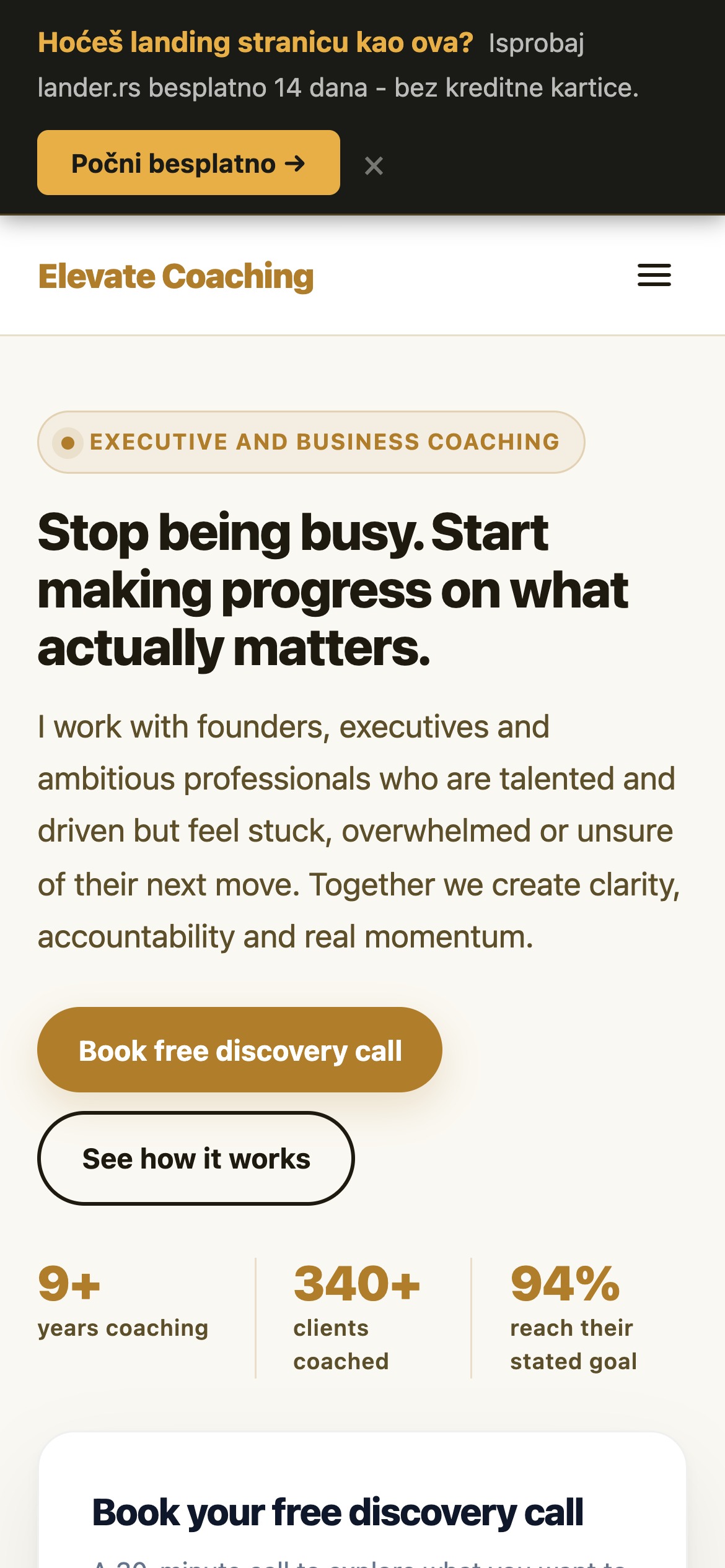
Mobile - headline, segmentation dropdown, and no-pressure CTA visible immediately
Specificity beats breadth
The single biggest mistake coaches make on their website is trying to speak to everyone. "I help people reach their potential" applies to nobody in particular. "I work with founders, executives, and ambitious professionals who are talented and driven but feel stuck, overwhelmed, or unsure of their next move" applies to a specific person who recognises themselves in it.
Elevate Coaching's hero subheading names the client profile precisely: "I work with founders, executives and ambitious professionals who are talented and driven but feel stuck, overwhelmed or unsure of their next move."
This level of specificity does something counterintuitive - it filters out the people who aren't a fit, and that filtering increases conversion from the people who are. A founder who reads this and thinks "that's exactly where I am" feels understood before the first conversation. That feeling of being understood is the primary driver of enquiry in coaching.
The badge above the headline reinforces the niche: "Executive and Business Coaching." Not "life coaching." Not "personal development." A badge that signals exactly who this is for allows the right visitor to self-select in immediately.
Anti-hype copy that converts
The coaching industry is full of transformation language: "10x your business," "unlock your full potential," "achieve the life you deserve." These phrases are so overused that they've become noise - and worse, they activate skepticism in the sophisticated buyers who make the best coaching clients.
Elevate Coaching's discovery call form uses the opposite approach. Below the submit button: "No sales pressure. Just an honest conversation about where you are and where you want to be."
This copy works because it explicitly addresses the objection most people have about booking a discovery call: fear that it's a sales pitch disguised as a consultation. By naming and dismissing that fear directly, it removes the last barrier to submitting the form.
More broadly, the page's copy is restrained and specific throughout. "Together we create clarity, accountability and real momentum" is a claim with substance - it names three concrete things the engagement delivers. Compare that to "I'll help you transform your life and business," which is a claim with no content.
The discovery call as conversion mechanism
The CTA on Elevate Coaching's page is not "book a session" or "enquire now." It's "Book your free discovery call." The form subheading explains exactly what this is: "A 30-minute call to explore what you want to achieve and how I can help."
This structure - a free, time-bounded, explicitly non-committal first step - is the optimal conversion mechanism for high-trust services. It works for the same reasons the free intro call works in therapy and the free case evaluation works in law: it removes financial risk from the first step and makes the ask feel proportionate to where the prospect is in their decision process.
Critically, the discovery call is not positioned as a sales call. It's positioned as a conversation where the prospect learns something useful - what they want to achieve and whether coaching with this person is the right vehicle for getting there. The prospect who leaves the discovery call with more clarity than they arrived with is already experiencing the value of coaching, whether they sign up or not.
Form segmentation increases lead quality
Elevate Coaching's discovery call form includes a "What best describes you?" dropdown - options include founder or entrepreneur, executive, team lead, and other. This segmentation field does something most coaching websites skip: it tells the coach who is enquiring before the first conversation.
For the visitor, selecting from a dropdown is lower friction than writing a paragraph about themselves. For the coach, it enables better preparation for the discovery call and better follow-up if the prospect doesn't immediately book. A founder enquiry and an executive enquiry have different contexts and different problems - knowing which you're dealing with before the call makes it more useful for everyone.
The segmentation dropdown also signals to the visitor that this coach works with different types of clients - not just one narrow profile - which broadens the perceived relevance of the page without losing specificity in the headline.
Results and track record over credentials
Coaching certifications (ICF, EMCC, various accreditation bodies) matter for professional credibility but they are not conversion drivers for sophisticated clients. What converts is evidence that the coach has produced results with people like them.
Elevate Coaching's hero stats are outcome-focused: 9+ years coaching, 340+ clients coached, 94% reach their stated goal. The 94% figure is particularly powerful - it's specific, verifiable-sounding, and it answers the implicit question "does coaching actually work?" with a concrete answer.
Testimonials in coaching should follow the same principle: specific challenge, specific change, specific outcome. "Working with [coach] helped me get clear on my priorities and I went from avoiding the hard conversations in my business to having them proactively. Revenue grew 40% in the 12 months we worked together." This is a testimonial that converts. "Great coach, highly recommend" is not.
Transparent pricing in a category that avoids it
Most coaches hide their pricing behind "contact for rates" or "pricing discussed on discovery call." This is understandable - coaching engagements vary in duration and scope - but it's a conversion barrier. Visitors who can't quickly assess whether the service is in their range will often leave rather than invest time in a discovery call to find out.
Publishing a starting-from price, or a clear structure (monthly retainer, per-session rate, 3/6/12 month package), answers the affordability question and converts the people who are in range. Those who aren't were never going to be clients. Pricing transparency also signals confidence - coaches who are proud of their rates publish them; coaches who are uncertain about their value hide them.
Landing page vs. generic coaching website
| Factor | Generic coaching website | Focused landing page |
|---|---|---|
| Headline | "Helping people reach their potential" | Names the specific problem the ideal client has |
| Target client | "Anyone who wants to improve" | "Founders and executives who feel stuck" |
| First CTA | "Contact me" or "Book a session" | "Free 30-minute discovery call - no sales pressure" |
| Methodology copy | Framework names and certification logos | Plain-language description of what the work involves |
| Social proof | Generic testimonials or LinkedIn endorsements | Outcome-specific quotes with measurable results |
| Pricing | "Contact for rates" | Published tiers or starting-from anchors |
| Typical conversion rate | 1–2% | 5–12% |
How to build one with lander.rs
Elevate Coaching's page was built in the lander.rs visual editor with no code. The structure for a business coaching landing page:
- ContentSection (hero) - problem-naming headline, client profile subheading, niche badge, 3-field discovery call form with segmentation dropdown, no-pressure footnote, results stats
- ImageSection - photo with the coach or a coaching setting, "built around your goals" caption
- Services (coaching areas) - 4-6 cards: clarity & direction, accountability, leadership, team performance, transitions, business strategy
- ImageWithText (background) - years building or running businesses, why that makes better coaching
- Testimonials - outcome-specific: challenge + change + measurable result
- ImageWithText (who it's for) - specific client profiles and the situations that bring them to coaching
- Pricing - monthly or package rates, what's included, free discovery call entry point
- CTASection - repeat the discovery call CTA with the 94% stat
- FAQ - how coaching works, session frequency, online or in-person, results timeline, how to know if ready
- ContactForm - name, email, what describes you best (select), what's your main challenge (textarea)
Build your coaching landing page
All the components above are available in lander.rs - no code, no designer, up in an afternoon. Your next discovery call booking could come from a page you build today.
Try lander.rs freeNo credit card required. Cancel any time.